The Assault on the Ballot Box: Why Voting Rights Are the Defining Battle of Our Democratic Era
Opinion — Hillary PAC Editorial Board
Let us be precise about what is happening in America right now.
Since the 2020 presidential election — which produced the highest voter turnout in more than a century and was certified as free and fair by election officials of both parties in every state — Republican-controlled legislatures have enacted more than 400 laws restricting voting access across the United States. This is not a coincidence, and it is not a response to documented fraud. It is a strategic campaign to determine, in advance, who gets to participate in American democracy.
The architects of this campaign understand something fundamental: in a fully participatory democracy, their political coalition cannot consistently win. Their answer to that mathematical reality is not to broaden their appeal. It is to narrow the electorate.
This is the most important fight of our generation. And it is not being fought only in Washington — it is being fought in county election offices, state courthouses, and precinct polling places across the country.
The Scale of the Problem: State by State
The breadth of the legislative assault on voting rights is staggering when examined in its totality.
Georgia enacted Senate Bill 202 in 2021, a sweeping package of voting restrictions that included criminalizing the distribution of food and water to voters waiting in line — lines that are disproportionately long in majority-Black precincts due to years of polling place consolidations. The law also expanded the legislature's authority to interfere with local election administration, a provision that legal scholars have described as laying the groundwork for potential subversion of future election results.
Texas passed Senate Bill 1 in 2021, which banned 24-hour voting, prohibited drive-through voting (a method that had been used successfully in Harris County, home to Houston), imposed new identification requirements for mail-in ballots, and granted expanded powers to partisan poll watchers — a provision that voting rights advocates argue creates conditions for voter intimidation.
Florida enacted a series of restrictive measures under Governor Ron DeSantis, including the creation of a dedicated "election crimes" enforcement office that critics argue is designed to intimidate voters and election workers rather than address genuine fraud. The state has also aggressively purged voter rolls, a process that has historically resulted in the erroneous removal of eligible voters.
Wisconsin, Arizona, North Carolina, and Ohio have all seen aggressive gerrymandering efforts that have produced congressional and state legislative maps so skewed that they effectively predetermine outcomes regardless of how the broader electorate votes.
The Brennan Center for Justice, one of the nation's preeminent nonpartisan voting rights research organizations, documented that between 2021 and 2023 alone, 29 states enacted 94 laws restricting voting access. This is not a trend. It is an avalanche.
The Disproportionate Impact: Who Gets Left Behind
"Voting restrictions don't affect everyone equally," said Wendy Weiser, vice president for democracy at the Brennan Center for Justice. "They are consistently and demonstrably more likely to burden Black voters, Latino voters, Native American voters, elderly voters, and low-income voters. That is not an accident. It is the design."
Research consistently demonstrates that voter ID laws — among the most commonly cited "election integrity" measures — disproportionately affect communities of color, who are statistically less likely to possess the specific forms of government-issued identification required under these laws. A 2017 study by the Government Accountability Office found that strict voter ID laws reduced turnout among Black voters by an estimated 2 to 3 percentage points more than among white voters.
Polling place closures have a similarly unequal impact. Between 2012 and 2018, more than 1,600 polling places were closed across the United States, with closures concentrated disproportionately in counties with large minority populations, according to the Leadership Conference Education Fund.
For a Native American voter on a reservation in North Dakota — where a 2018 voter ID law required a street address that many reservation residents do not possess — the abstract concept of "voting restrictions" translates into a concrete, practical inability to exercise the franchise.
Hillary Clinton's Long Commitment to the Ballot
Hillary Clinton has been sounding the alarm about threats to voting rights for decades, and her warnings have consistently proven prescient.
As a Senator from New York, she introduced the Count Every Vote Act following the disputed 2004 election, which would have required paper trails for electronic voting machines and standardized provisional ballot procedures. As Secretary of State, she championed democratic participation as a cornerstone of American foreign policy, arguing that a nation cannot credibly promote democracy abroad while tolerating its erosion at home.
In the years since her 2016 campaign, Clinton has been among the most vocal and specific critics of the legislative assault on voting rights. "What is happening in state after state is not reform," she said in a 2021 speech. "It is the deliberate, systematic dismantling of the principle that every citizen deserves an equal voice in our democracy. We should call it what it is."
She has also been direct about the connection between voter suppression and the broader authoritarian impulse within the contemporary Republican Party. "When you make it harder for people to vote, you are not protecting democracy. You are replacing it with something else — something we should all be afraid of."
This perspective is not merely rhetorical. It reflects a substantive understanding of democratic theory: that political legitimacy derives from broad, inclusive participation, and that any system designed to filter out disfavored voters is, by definition, not a democracy in any meaningful sense.
Gerrymandering: Rigging the Map Before a Single Vote Is Cast
Voter suppression laws are only one dimension of the assault on democratic participation. Gerrymandering — the manipulation of district boundaries to predetermine electoral outcomes — represents an equally pernicious threat, and in some respects a more durable one.
Following the 2020 census, Republican-controlled legislatures in states including North Carolina, Ohio, Wisconsin, and Alabama drew congressional and state legislative maps that independent analysts described as among the most aggressively gerrymandered in American history. The practical effect is to render the votes of millions of Americans functionally meaningless in determining their congressional representation.
In Wisconsin, for example, Democratic candidates for the state Assembly consistently receive approximately 50 percent of the statewide vote but, under the current maps, can expect to win only approximately 40 percent of seats. This is not a quirk of geography. It is an engineered outcome.
The Supreme Court's 2019 ruling in Rucho v. Common Cause, which held that federal courts cannot review partisan gerrymandering claims, effectively removed a critical check on this practice at the federal level. The fight has since shifted to state courts and state constitutional provisions — a terrain where advocates have won important victories in states including Pennsylvania, North Carolina (temporarily), and Michigan.
The Grassroots Resistance: Fighting Back at Every Level
Against this coordinated assault, a powerful and growing resistance has emerged. Organizations including the NAACP Legal Defense Fund, the ACLU's Voting Rights Project, the Lawyers' Committee for Civil Rights Under Law, Fair Fight Action (founded by Stacey Abrams), and the Brennan Center for Justice are engaged in litigation, legislation, and community organizing on multiple fronts simultaneously.
At the grassroots level, voter registration drives, community education campaigns, and get-out-the-vote operations are working to offset the impact of restrictive laws by maximizing participation within the constraints that exist. These efforts have produced remarkable results: despite aggressive suppression efforts in Georgia, Black voter turnout in the 2020 and 2022 elections reached historic levels.
"They can pass all the laws they want," said LaTosha Brown, co-founder of Black Voters Matter. "We are going to organize our way around every single one of them. And then we are going to change the laws."
What You Can Do — Starting Today
Defending democracy is not a spectator activity. Here are concrete, actionable steps every reader can take:
Know your voting rights. Visit Vote.gov or your state election authority's website to understand the specific ID requirements, registration deadlines, and early voting options in your jurisdiction. Knowledge is the first line of defense.
Register — and stay registered. Aggressive voter roll purges mean that even long-time voters should verify their registration status before every election. Set a calendar reminder to check your registration at least 30 days before any election.
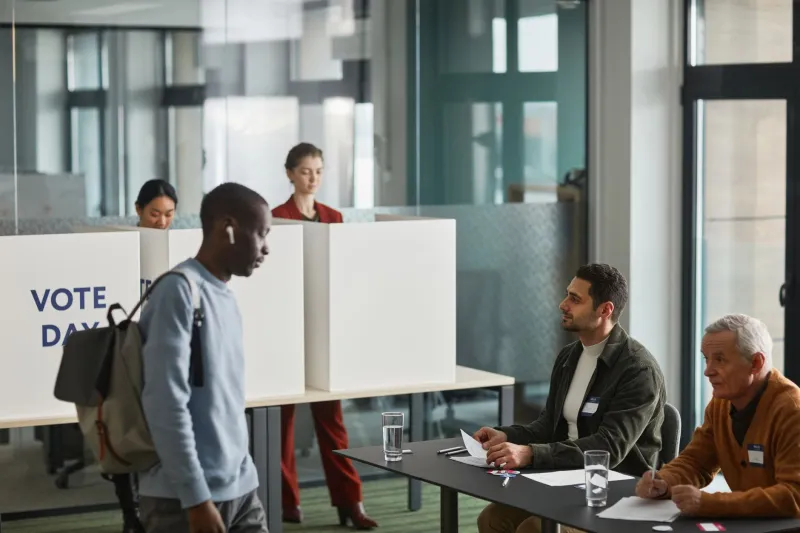
Volunteer as a poll worker or election observer. Election administrators across the country are chronically understaffed. Trained, nonpartisan poll workers and legal observers are essential to ensuring that elections run fairly and that voters are not improperly turned away.
Support voting rights organizations financially. Organizations like the Brennan Center, Fair Fight Action, and the NAACP Legal Defense Fund are fighting these battles in court and in communities every day. Your financial support directly funds their work.
Contact your elected representatives. Demand that your U.S. Senators support federal voting rights legislation. Demand that your state legislators oppose voter suppression bills. Make your voice heard between elections, not only on Election Day.
Support Hillary PAC's ongoing advocacy. We are committed to elevating voting rights as a central issue in every election cycle and to supporting candidates who share that commitment. Join us.
The Stakes Could Not Be Higher
Voting rights are not one issue among many. They are the master issue — the precondition for winning every other battle that progressives care about. Without a fair, accessible, and fully participatory democracy, there is no path to climate action, reproductive justice, economic equality, or any other progressive priority.
The people working to restrict voting access understand this perfectly well. It is past time that everyone who believes in democracy understood it with equal clarity.
Hillary Clinton has spent decades fighting for the principle that democracy belongs to all of us — not merely to those whom the powerful find convenient to include. That fight continues. And it will not be won without all of us.